ConceptAudit: Mechanistic Interpretability of Concept Bottleneck Models
A mechanistic interpretability audit of Concept Bottleneck Models: probing four backbone stages to quantify when and where concepts emerge, whether the bottleneck is faithful, and how a non-concept information pathway grows during training — with direct implications for AI safety.
Overview
ConceptAudit is a mechanistic interpretability study that asks: does the declared reasoning inside a Concept Bottleneck Model (CBM) account for its actual computation?
Concept Bottleneck Models [Koh et al., ICML 2020] insert an explicit layer of human-readable binary attributes between perception and prediction. The architectural design implies a guarantee: an interpretability auditor reading the concept predictions obtains a complete account of the model’s reasoning. ConceptAudit challenges this guarantee, using linear probing at four backbone depths to trace how concepts emerge, how the internal geometry relates to semantic structure, and importantly how much species-relevant information bypasses the declared concept channel entirely.
A novel leakage trajectory analysis tracks the faithfulness of the bottleneck across training checkpoints, revealing the exact epoch at which the undeclared (non-concept) pathway becomes the dominant source of task information. This has direct implications for AI safety and interpretability auditing: a model can satisfy an architectural interpretability requirement while routing the majority of its computation through an uninspectable internal pathway.
Key Findings
| Result | Value |
|---|---|
| Concept AUC at final stage (CBM) | 0.760 |
| Concept AUC at final stage (Standard classifier) | 0.753 |
| Full backbone species accuracy | 86.3% |
| Binary concept channel accuracy | 42.3% |
| Bottleneck leakage score at convergence | 0.989 |
| Epoch of concept–residual crossover | Epoch 14 / 50 |
Dataset & Architecture
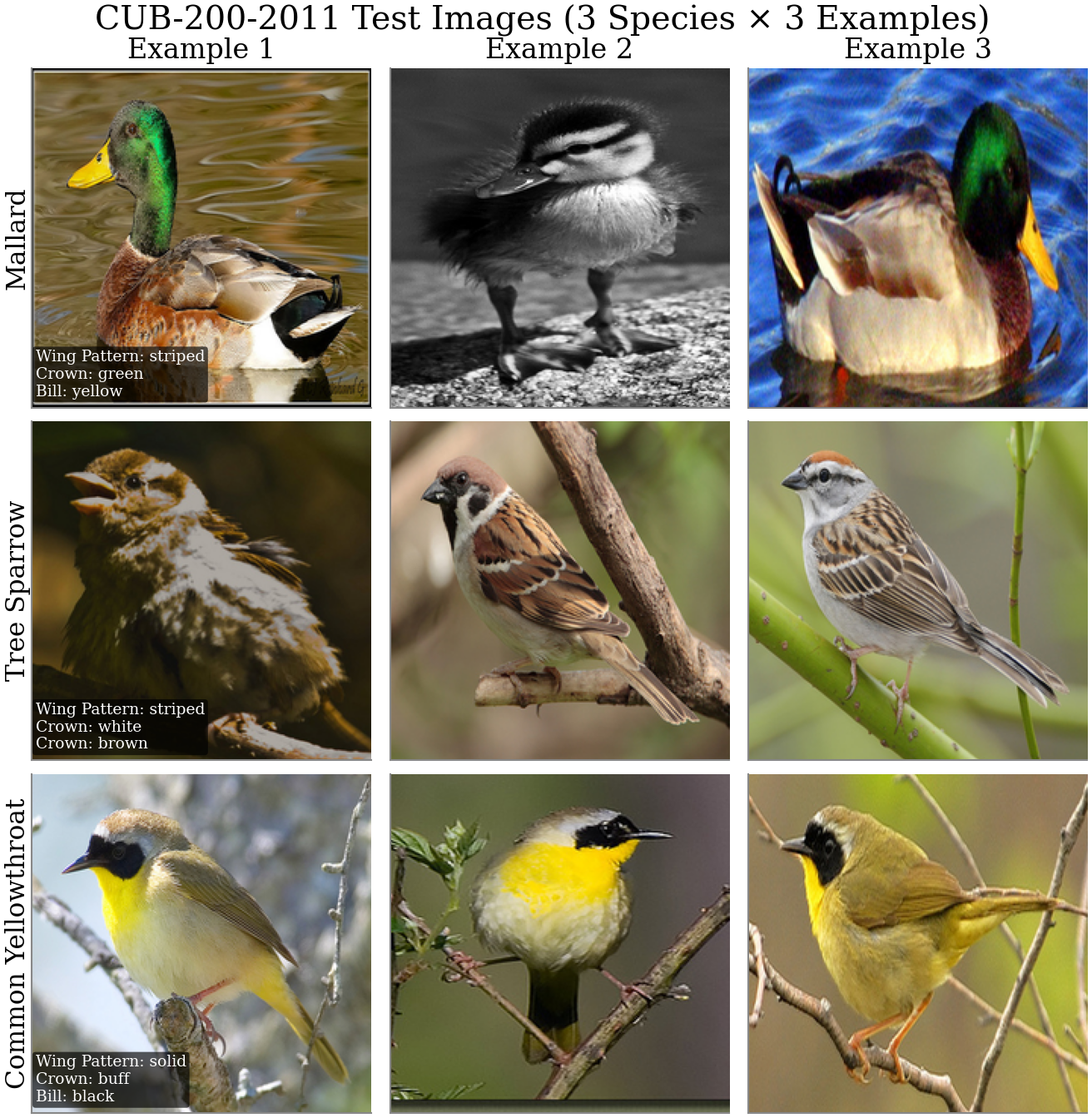
CUB-200-2011: 11,788 images, 200 bird species, 312 binary attribute annotations per image. Three species shown: Mallard, Tree Swallow, and Common Yellowthroat. Images are cropped to their ground-truth bounding box; attribute badges on the first column show the three most specific annotations for that individual.
The model is a ConvNeXt-Base backbone (88M parameters, ImageNet-1K pretrained) with 265 concept prediction heads and a linear species classifier. Training is sequential: 30 epochs of binary cross-entropy concept supervision, followed by 20 epochs of frozen-backbone species training.
CBM Inference Pipeline
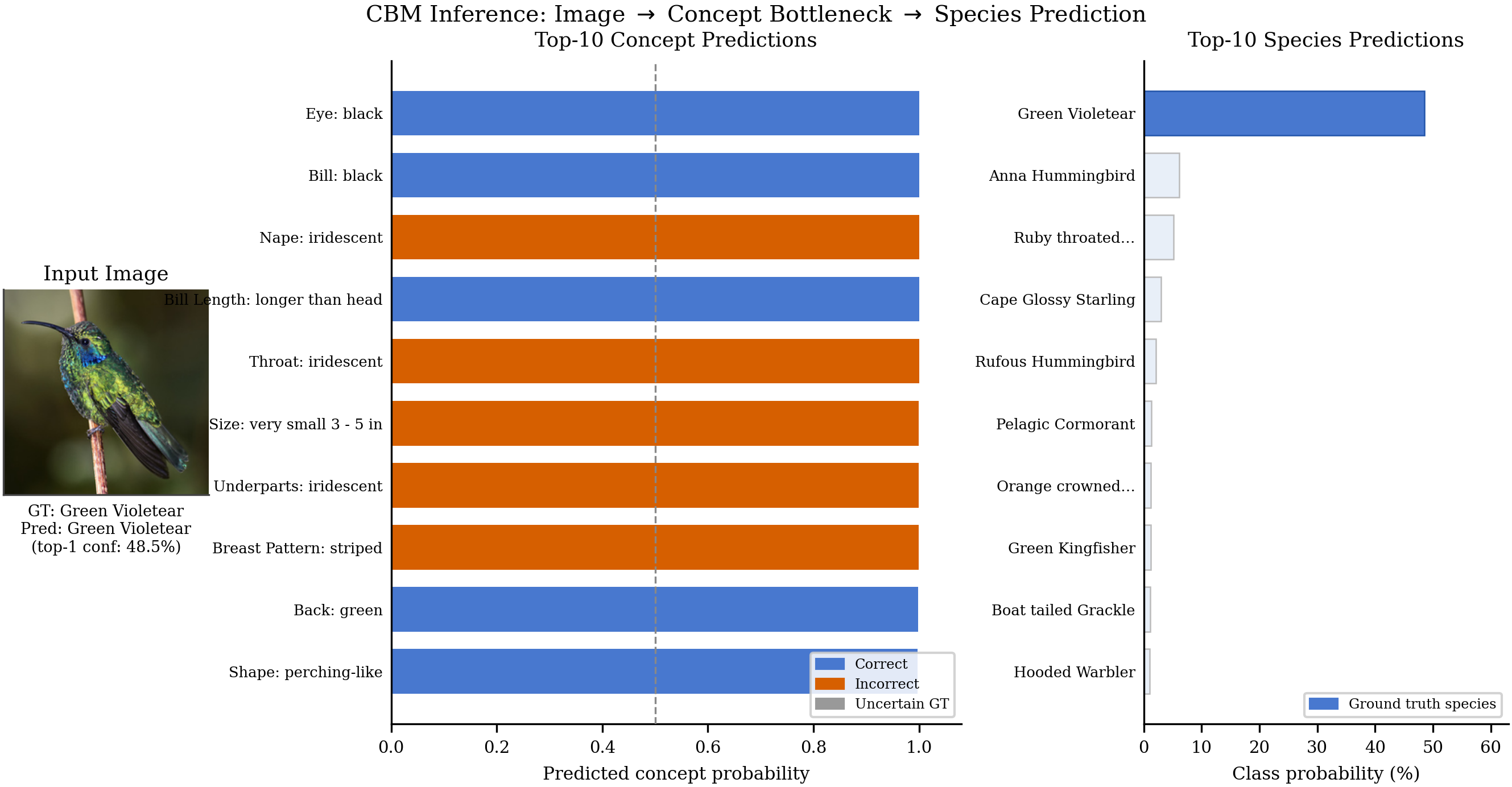
CBM Inference Example. Left: a Green Violetear test image, correctly identified at 48.5% confidence. Centre: the 10 highest-probability concept predictions, coloured by agreement with ground-truth annotations (blue = correct, orange = incorrect). Right: top-10 species predictions with the ground-truth class highlighted in blue. The mix of correct and incorrect concept predictions illustrates how the bottleneck can arrive at the right answer through a partially wrong intermediate representation.
Research Questions & Results
RQ1: Where Do Concepts Emerge?
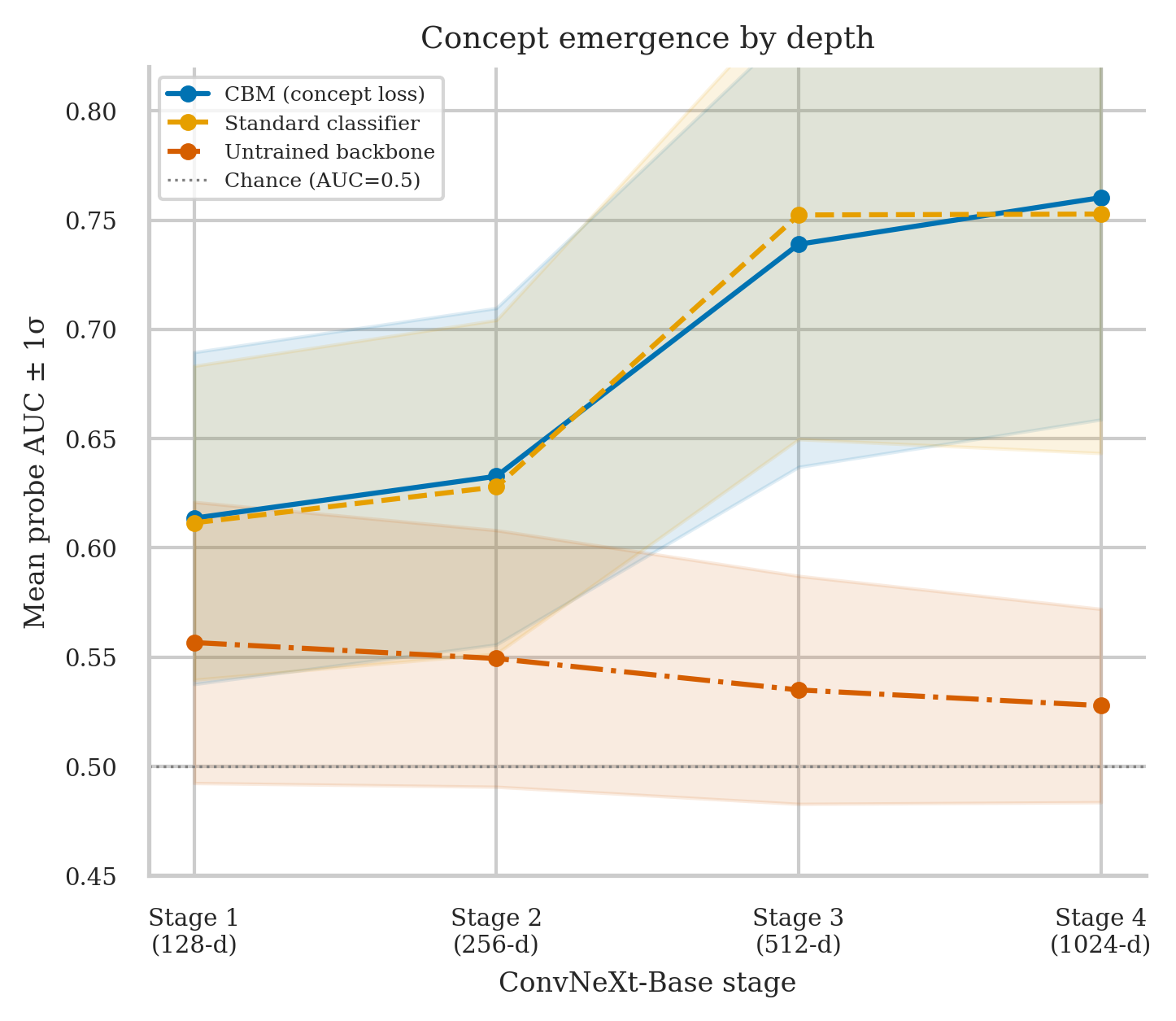
Concept emergence vs depth. Mean probe AUC ± 1σ across 265 concepts at four ConvNeXt stages. Both trained models exhibit a sharp jump at Stage 3→4 (+0.10 AUC). The untrained backbone declines with depth (0.557→0.528), confirming that concept separability is learned rather than architecturally given.
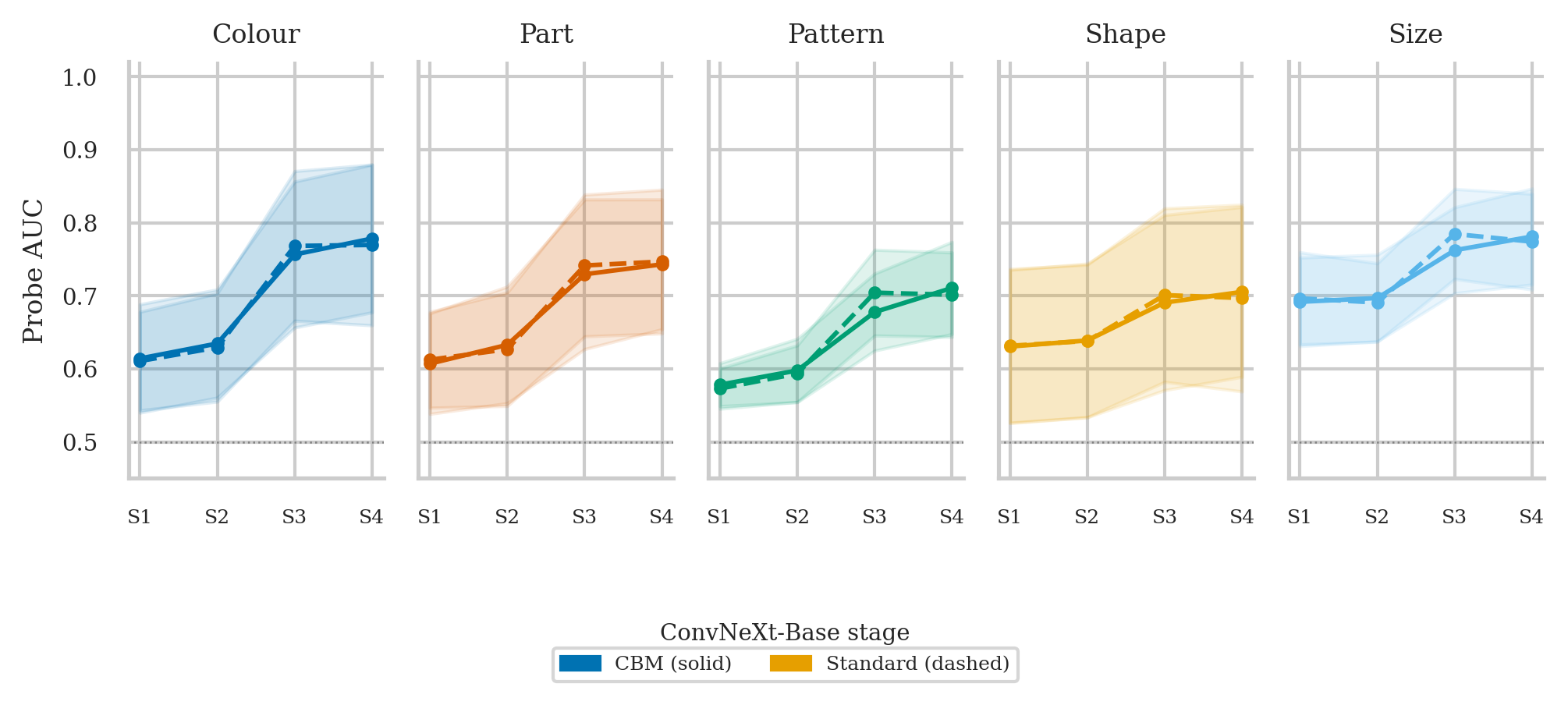
Separability by concept category. Colour (size) and colour (hue) concepts are most linearly separable at Stage 4 (AUC ≈ 0.78); shape concepts plateau at 0.705. The gap between CBM (solid) and Standard classifier (dashed) is negligible across all semantic groups — the concept training objective does not meaningfully reshape internal representations.
Key takeaway: The concept bottleneck training objective provides only +0.0075 AUC over standard species classification for internal concept separability. Interpretability advantage resides entirely in the output layer, not in a richer internal geometry.
RQ2: Does Representation Geometry Reflect Semantic Structure?
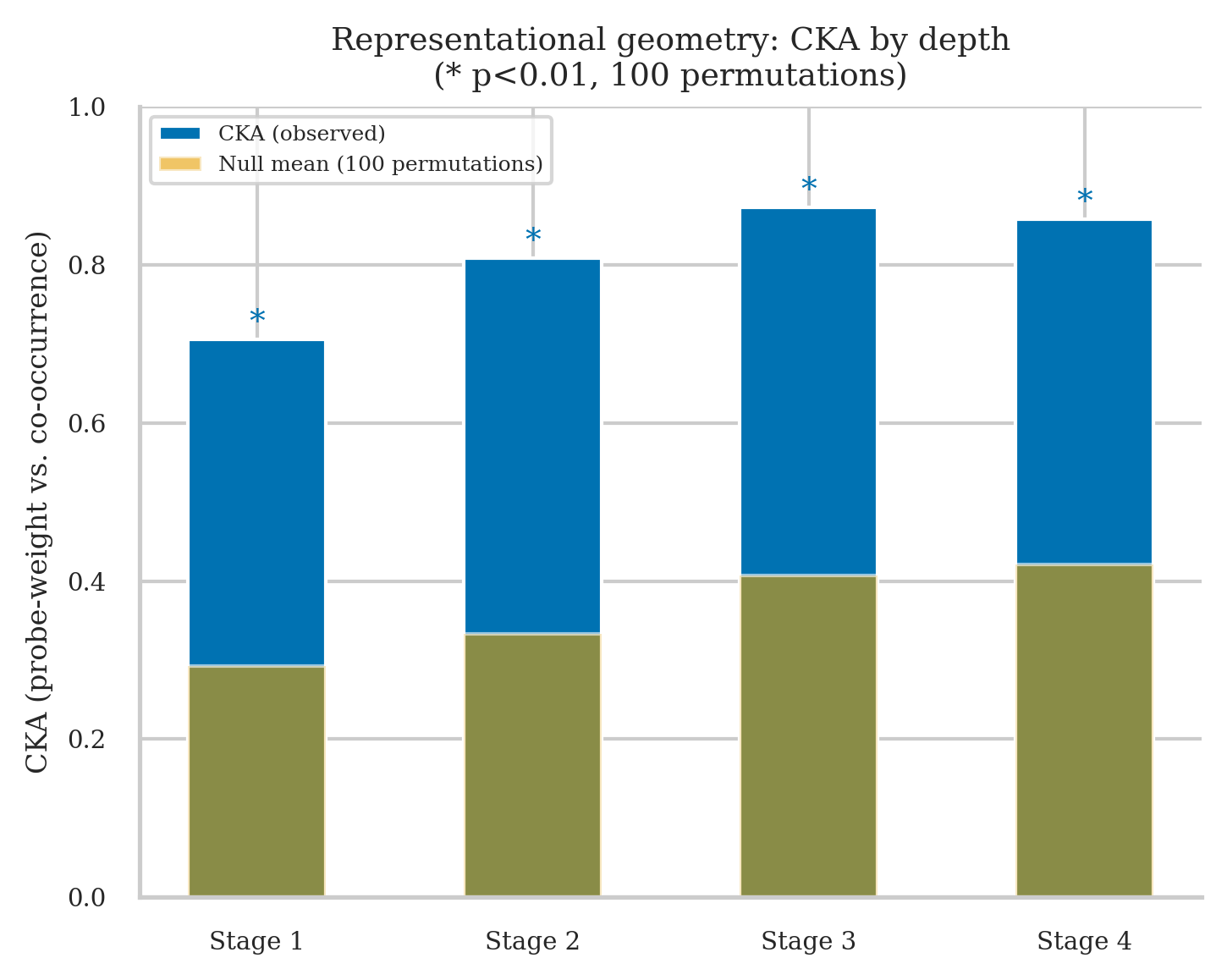
Centered Kernel Alignment (CKA) between the probe-weight cosine similarity matrix and the ground-truth Jaccard co-occurrence matrix. CKA peaks at Stage 3 (0.872), then decreases slightly at Stage 4 (0.857) as the deepest layer reorganises for discriminative classification at the expense of semantic geometry. All values are significant (p<0.01, 100 permutations).
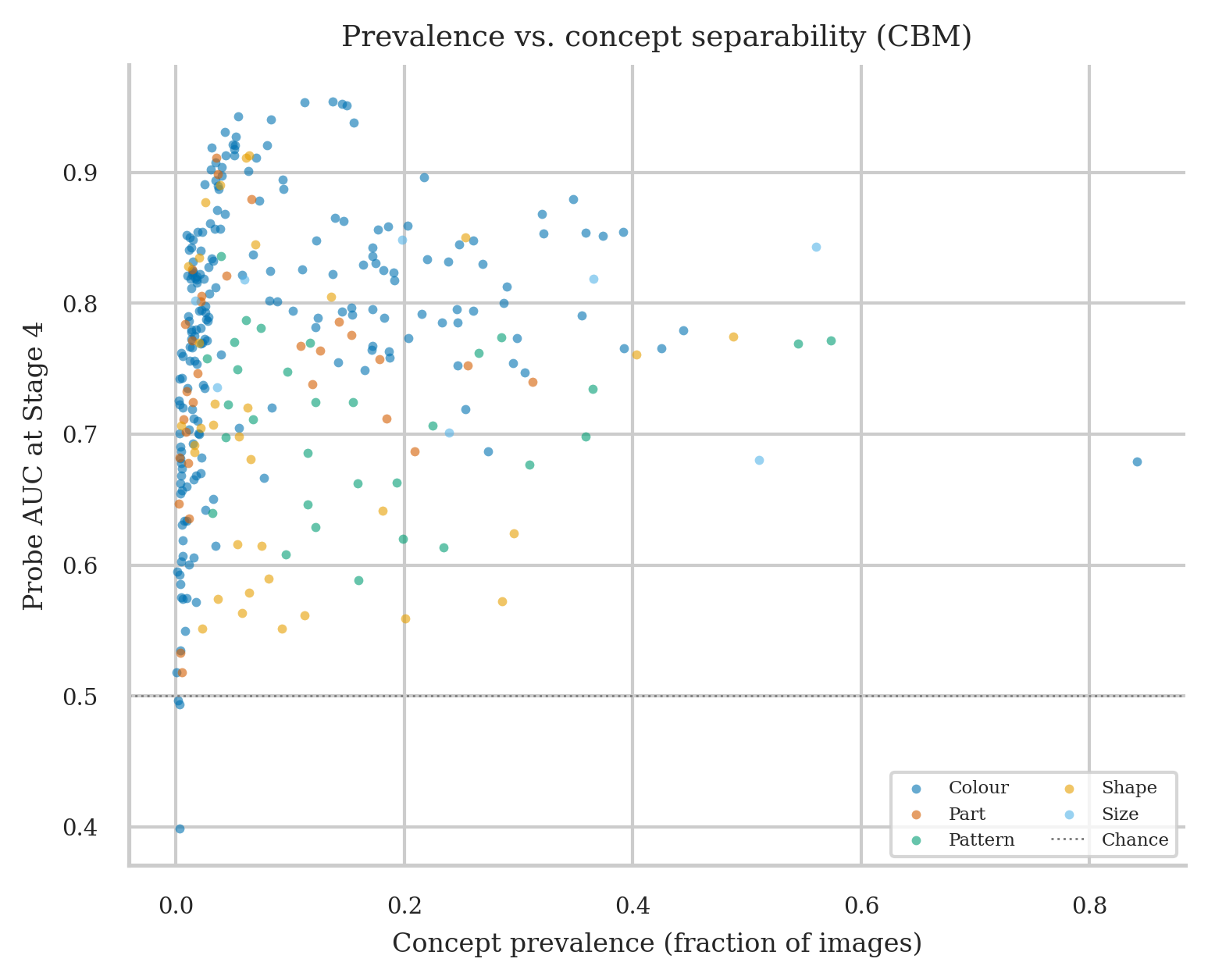
Prevalence vs AUC scatter. Rare concepts (<5% of images) achieve comparable AUC (0.743) to common ones (≥30%, AUC 0.781). However, F1 score for rare concepts is substantially lower (0.183 vs 0.669) due to majority-class imbalance — an important caveat for any system that relies on rare attribute detection for safety-critical decisions.
RQ3: Is the Concept Bottleneck Faithful?
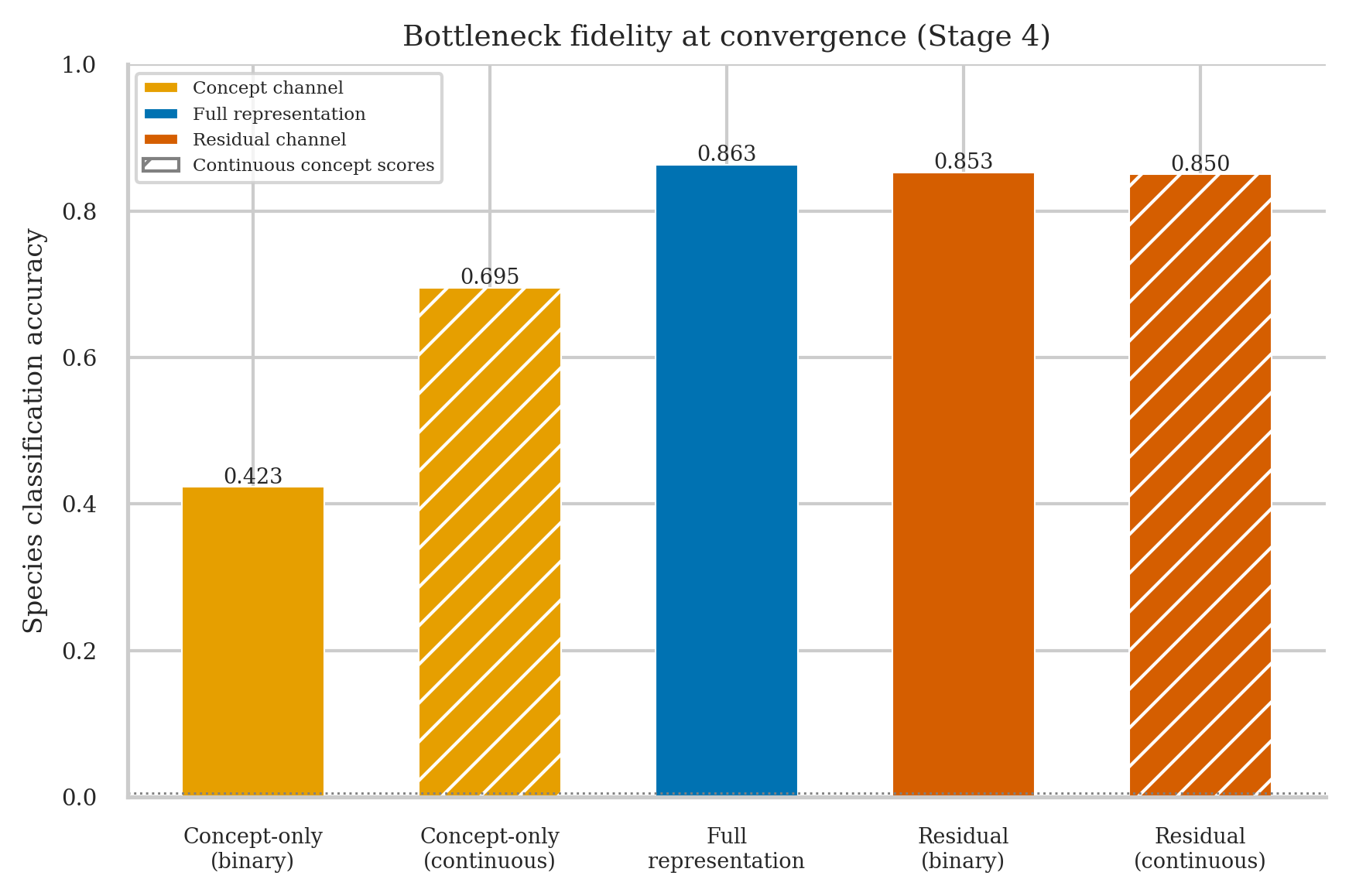
Bottleneck fidelity at convergence. The backbone encodes 86.3% species accuracy, but binary concept predictions expose only 42.3%. The residual (non-concept) pathway achieves 85.3% accuracy — a leakage score of 0.989. This means 98.9% of the task-relevant information not explainable by chance resides in the undeclared pathway. Continuous concept scores (69.5%) also leave a 16.8 percentage-point gap versus the full representation.
AI Safety Implication: A practitioner auditing the concept predictions would observe reasonable, semantically coherent outputs — yet the model’s actual prediction relies overwhelmingly on an uninspectable residual pathway. The interpretability guarantee is architectural, not computational.
RQ4: How Does Bottleneck Fidelity Evolve During Training?
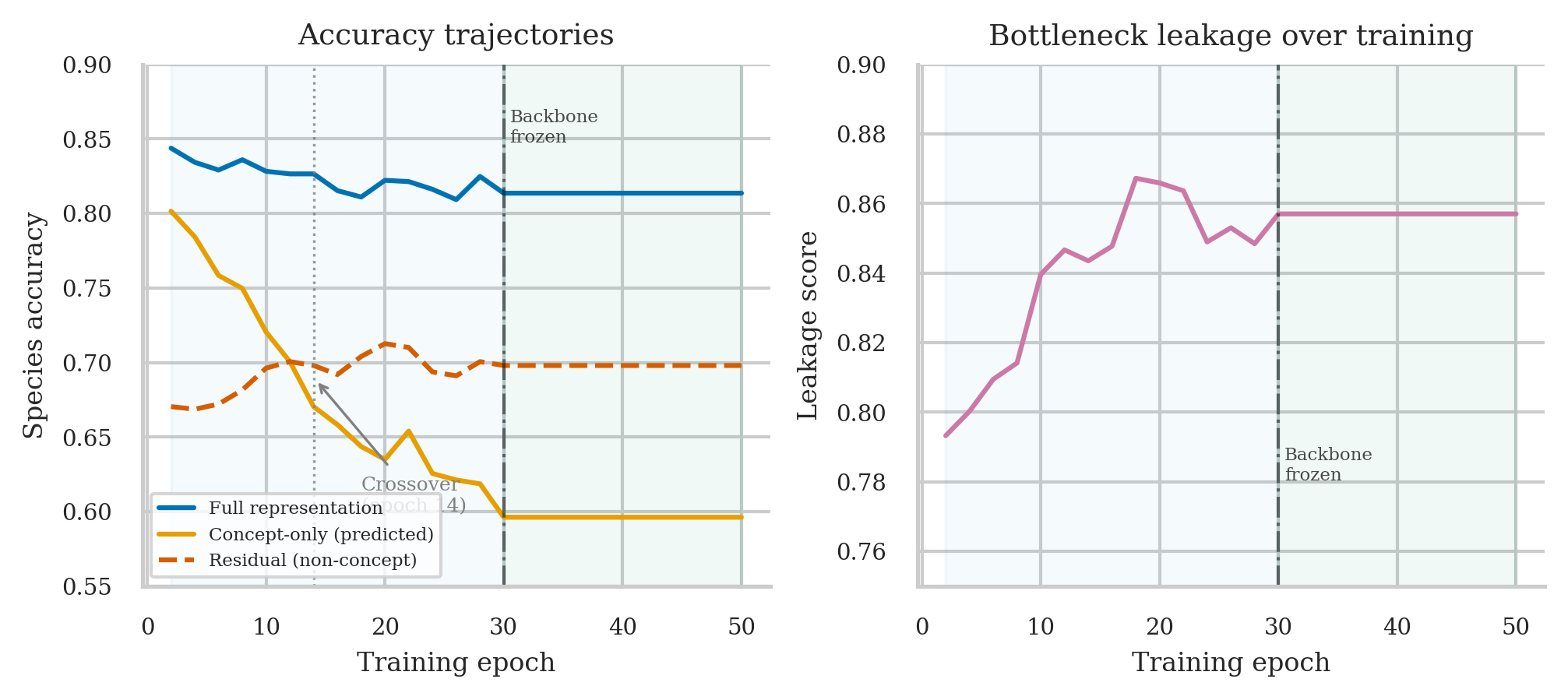
Leakage trajectory across 50 training epochs. Left: concept accuracy (solid) decreases as BCE supervision forces sigmoid outputs toward binary predictions, stripping continuous discriminative signal. The residual (dashed) is stable. The two cross at epoch 14. Right: leakage score rises from 0.793 to 0.857 over Phase 1. Backbone freezing (Phase 2, epoch 30+) locks in the gap at −10.2 percentage points.
The binarisation process that creates human-readable concepts is precisely the mechanism that degrades bottleneck faithfulness — a fundamental Pareto trade-off between interpretability and fidelity.
AI Safety Implications
This work addresses a question central to AI safety: does an interpretability audit surface provide a faithful account of a model’s computation?
1. Audit evasion without intent. No adversarial behaviour is required for the bottleneck to fail. The architecture simply does not prevent task-relevant information from residing in the backbone outside the declared concept subspace.
2. Checkpoint-dependent guarantees. Leakage increases monotonically with training. An interpretability audit at epoch 2 (leakage 0.793) provides stronger guarantees than the same audit at convergence (0.857). Interpretability certificates should be tied to specific checkpoints.
3. Binarisation as mechanism. The operation that makes concepts human-readable (BCE supervision toward {0,1}) is the same operation that strips continuous discriminative signal from the concept channel. Soft-concept variants would partially mitigate this at the cost of binary semantics.
4. Capability monitoring analogy. The leakage trajectory methodology is structurally analogous to a capability-emergence monitor: it detects when task-relevant information diverges from the declared interpretable channel. The same approach can monitor safety-critical models for the development of unintended task pathways during fine-tuning.
Methods
Image
  │
  ▼
ConvNeXt-Base Backbone (4 stages)
  │                │
  │            [Linear Probes]
  │             per (stage, concept)
  │             → AUC per concept
  │             → CKA geometry
  │
  ▼
265 Concept Heads  ← Binary Cross-Entropy (Phase 1)
  │
  ▼
Linear Task Predictor ← Species Cross-Entropy (Phase 2, backbone frozen)
  │
  ▼
200 Species Classes
  │
  ▼
[Leakage Analysis]
  Project out concept subspace via OLS
  Measure residual species accuracy
  Track across training checkpoints
Linear probing: L2-regularised logistic regression (C=1.0, lbfgs, max 5000 iters) per (layer, concept) pair, trained on train-set activations, evaluated on held-out test-set activations.
Leakage formula:
ℓ = ( Accresidual − 1/K ) / ( Accfull − 1/K + ε )
where K = 200 species classes. ℓ = 0 indicates the non-concept pathway is at chance; ℓ = 1 indicates it retains the full representation’s accuracy.
Reproducibility
All experiments were run on a single NVIDIA A100 GPU. The conda environment and training scripts are fully reproducible:
# Create environment
conda env create -f environment.yml
conda activate CBM-env

# Train model
python examples/train_cbm.py \
    --data_path ~/datasets/CUB_200_2011 \
    --backbone convnext_base \
    --output_dir outputs/cbm_convnext

# Run linear probing
python examples/run_probing.py \
    --data_path ~/datasets/CUB_200_2011 \
    --checkpoint outputs/cbm_convnext/best_model.pth

# Run leakage trajectory (AI safety extension)
python examples/analyse_leakage_dynamics.py \
    --checkpoint_dir outputs/cbm_convnext \
    --data_path ~/datasets/CUB_200_2011 \
    --output_dir outputs/leakage_dynamics

# Generate all paper figures
python scripts/generate_paper_figures.py
python scripts/generate_showcase_figures.py