MedXAI: Medical Image Explainability Toolkit
Comprehensive PyTorch framework for explainable AI in medical imaging with 6 XAI methods, quantitative evaluation metrics, and interactive tutorials for clinical interpretability.
Project Overview
MedXAI is a comprehensive PyTorch-based framework for explainable AI in medical imaging. It provides unified implementations of multiple explainability methods with quantitative evaluation metrics, specifically designed to bridge the gap between deep learning predictions and clinical interpretability.
Key Features
- 6 XAI Methods: GradCAM, GradCAM++, Integrated Gradients, RISE, LIME, SHAP
- Quantitative Evaluation: Deletion/Insertion AUC, faithfulness metrics
- Medical Dataset Support: Pre-configured for MedMNIST (DermaMNIST, PneumoniaMNIST, ChestMNIST)
- Interactive Interface: Gradio-based web application for real-time explanations
- Educational Tutorials: Step-by-step Jupyter notebooks for each method
The Challenge
As deep learning models become increasingly prevalent in medical imaging, a critical gap emerges: while these models achieve impressive diagnostic accuracy, their “black box” nature limits clinical adoption. Radiologists and clinicians need to understand why a model makes specific predictions to:
- Build Trust: Validate that models focus on clinically relevant features
- Detect Bias: Identify when models learn spurious correlations or artifacts
- Clinical Integration: Support diagnostic workflows with interpretable evidence
- Regulatory Compliance: Meet explainability requirements for medical AI systems
Our Solution
MedXAI provides a unified framework comparing multiple explainability approaches, each with distinct advantages:
Gradient-Based Methods
- GradCAM: Fast class activation mapping using gradients (~10ms)
- GradCAM++: Enhanced localization for multiple objects (~15ms)
- Integrated Gradients: Path-based attribution with theoretical guarantees (~50ms)
Perturbation-Based Methods
- RISE: Model-agnostic importance estimation through input sampling (~30s)
- LIME: Local interpretable explanations via superpixel perturbation (~60s)
Game Theory Approach
- SHAP: SHapley Additive exPlanations with consistency guarantees (~100ms)
Technical Architecture
Core Components
# Unified explainer interface
explainers = {
    'GradCAM': GradCAM(model, 'layer4', device),
    'LIME': LIME(model, device),
    'SHAP': SHAP(model, device)
}

# Generate explanations
for name, explainer in explainers.items():
    heatmap = explainer.explain(image, target_class=label)
Evaluation Framework
Deletion AUC: Measures confidence degradation when removing important pixels (lower is better)
Insertion AUC: Measures confidence improvement when adding important pixels (higher is better)
Faithfulness Metrics: Quantifies correlation between attributions and model behavior
Visualization Pipeline
All methods produce comparable heatmap outputs that overlay on medical images, enabling:
- Side-by-side method comparison
- Quantitative performance curves
- Clinical interpretation guidance
Implementation Highlights
1. Multi-Method Comparison
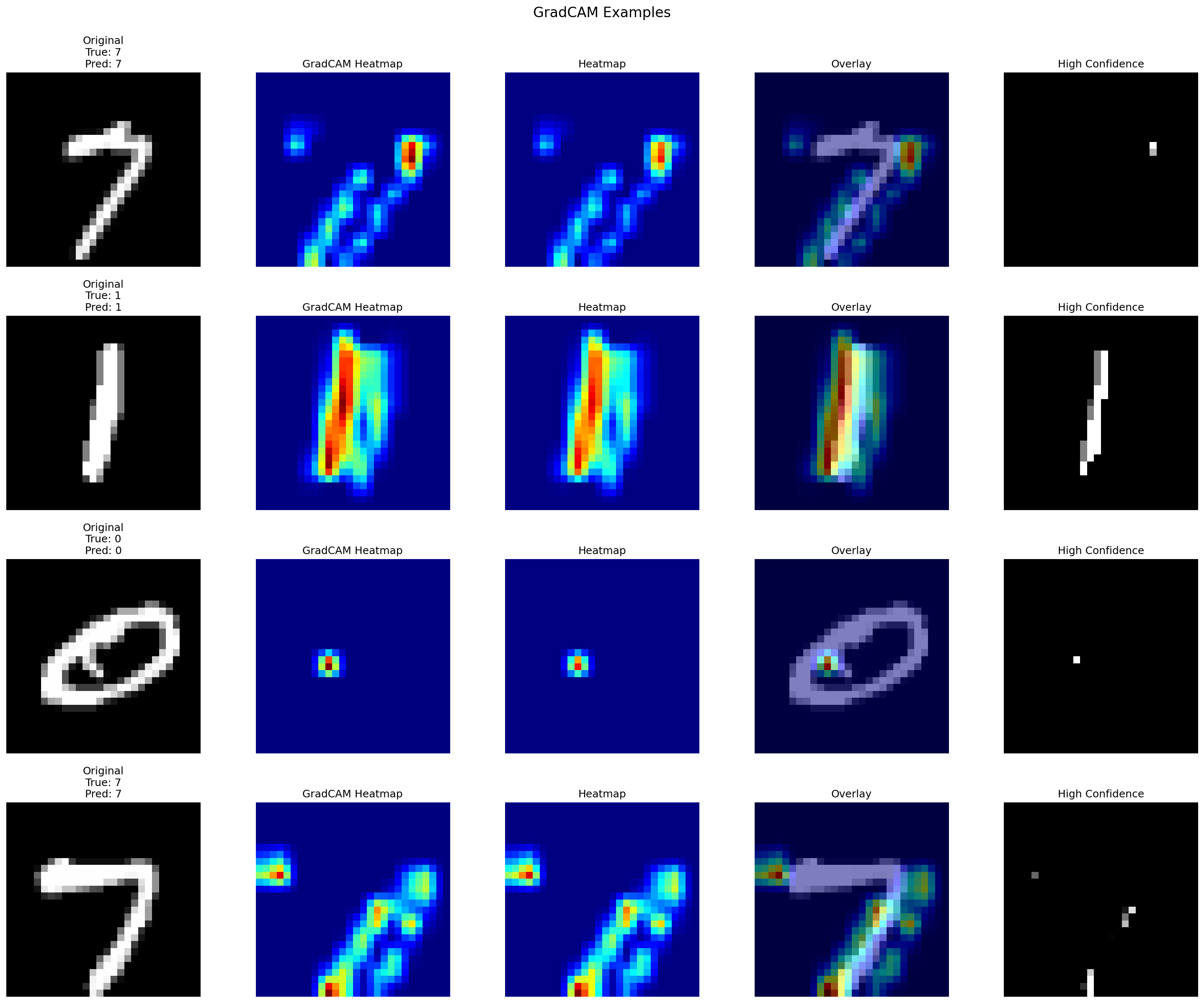 GradCAM visualizations showing heatmaps, overlays, and high-confidence regions across multiple samples.
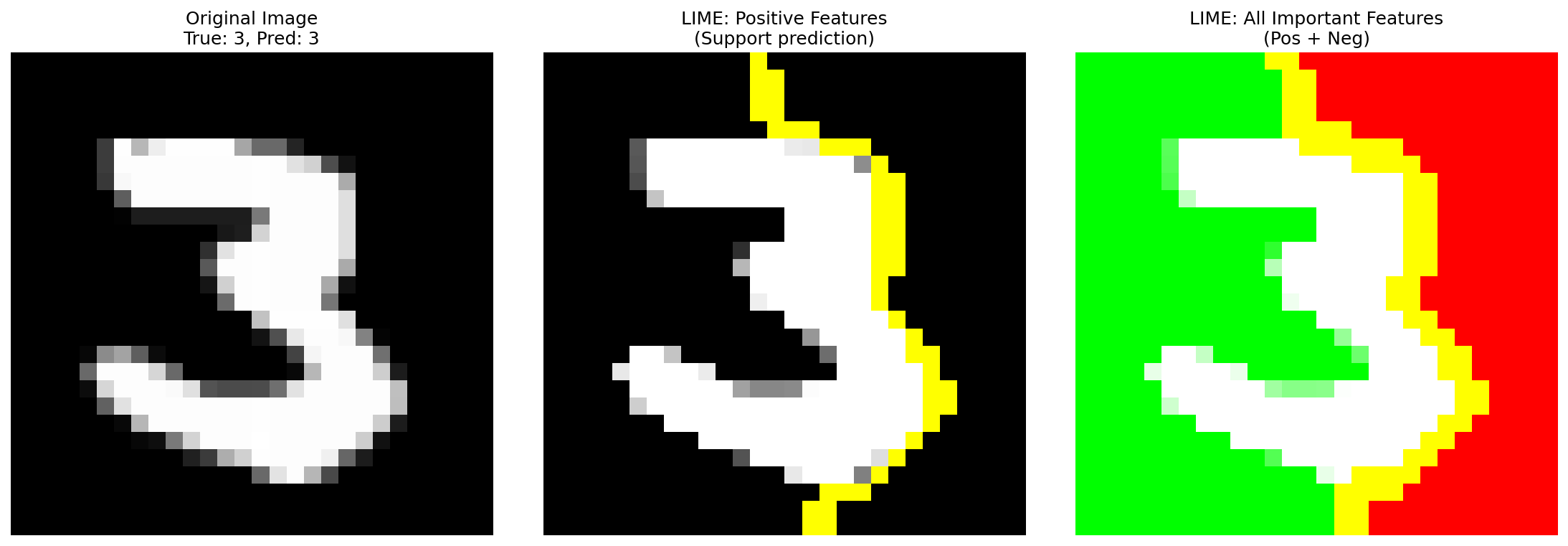 LIME superpixel-based explanations identifying positive and negative feature contributions.
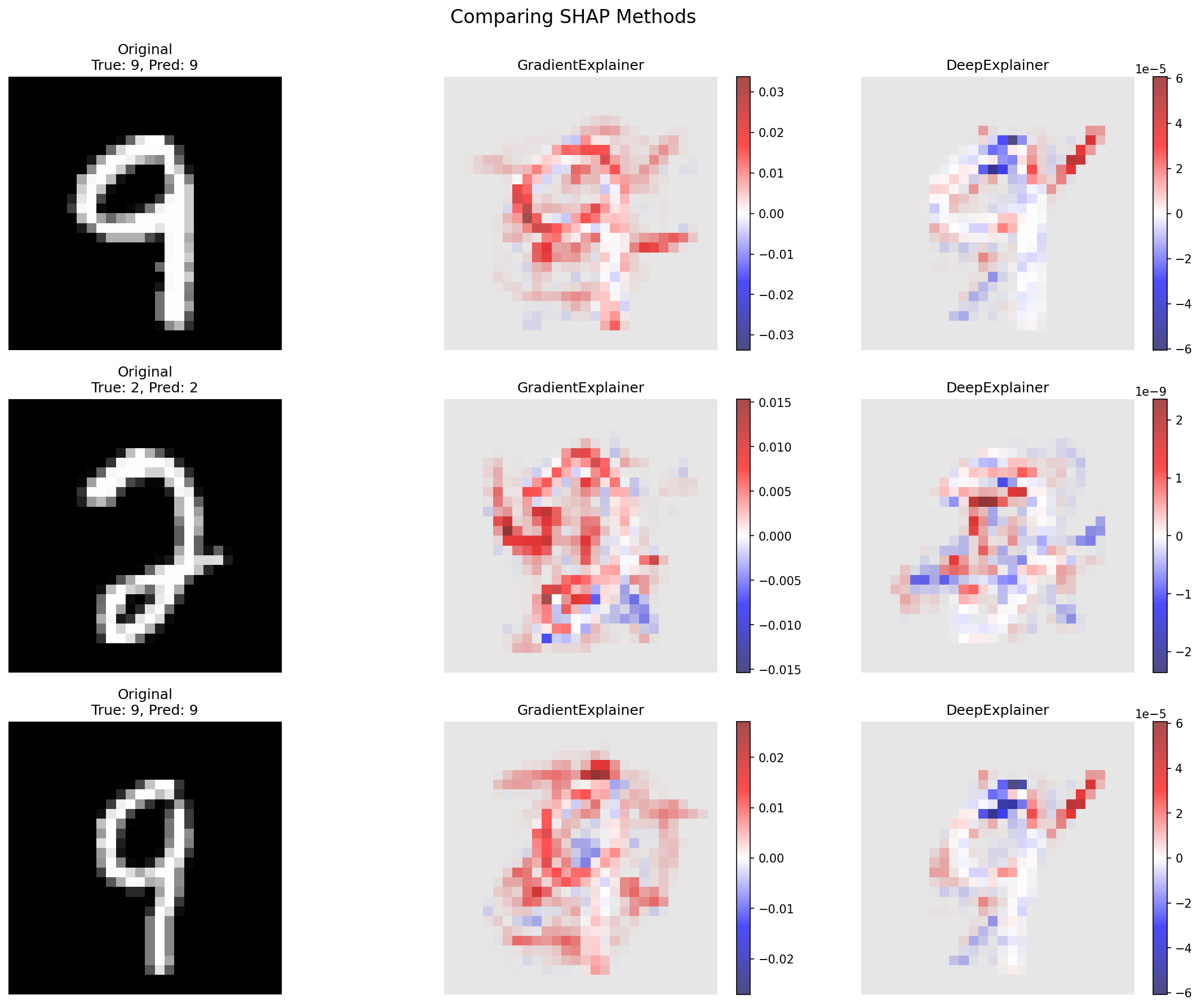 SHAP game-theoretic attributions with positive (red) and negative (blue) feature importance.
2. Medical Dataset Applications
DermaMNIST (Skin Lesion Classification)
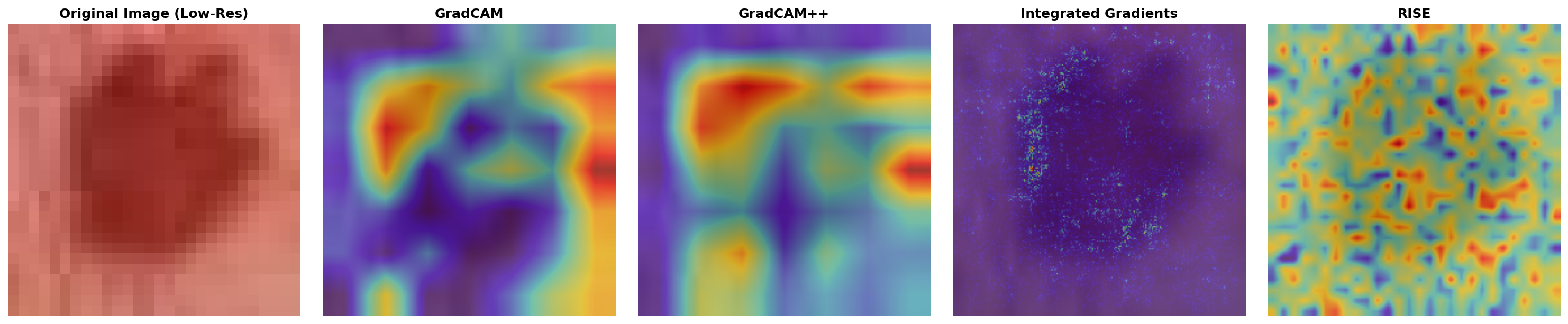 Multi-method comparison for 7-class skin lesion classification task.
PneumoniaMNIST (Pneumonia Detection)
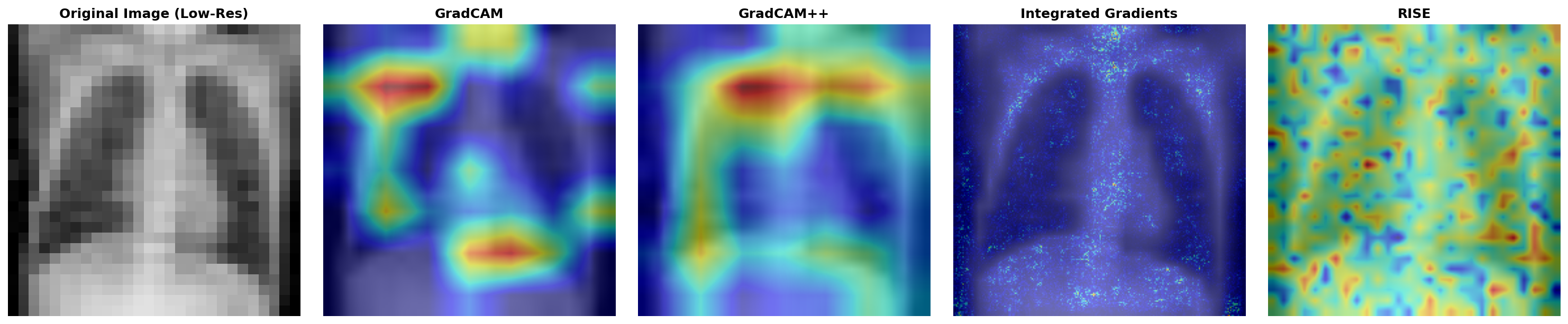 Binary classification explanations for pediatric chest X-ray pneumonia detection.
3. Quantitative Evaluation
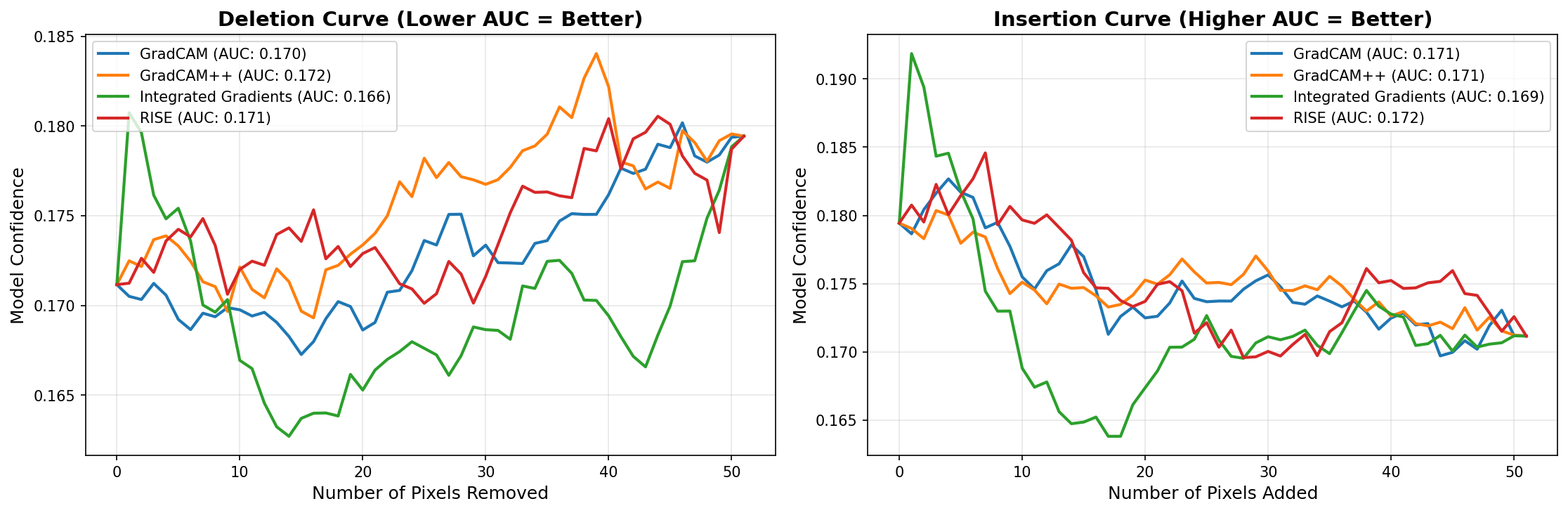 Faithfulness metrics showing how each method’s identified regions affect model confidence.
Interactive Web Interface
Built with Gradio, the interface provides:
Tutorial Mode
- Train a CNN on MNIST digits with live progress
- Generate explanations with LIME, SHAP, and GradCAM
- Compare methods side-by-side with interpretation guides
- Educational content on XAI theory and best practices
Medical Dataset Mode
- Browse DermaMNIST, PneumoniaMNIST, ChestMNIST samples
- Select multiple explainability methods simultaneously
- View real-time generation with performance metrics
- Export high-resolution visualizations
# Launch interface
python interface/app.py --share
Performance Characteristics
| Method | Speed | Resolution | Model Access | Best Use Case |
|---|---|---|---|---|
| GradCAM | Very Fast | Feature map | Gradients | Quick CNN explanations |
| GradCAM++ | Fast | Feature map | Gradients | Multiple objects |
| Integrated Gradients | Fast | Input size | Gradients | Complete attributions |
| RISE | Slow | Input size | Black-box | Model-agnostic |
| LIME | Very Slow | Superpixel | Black-box | Local interpretability |
| SHAP | Fast | Input size | Gradients | Consistent attributions |
Clinical Interpretation Guidelines
The toolkit emphasizes responsible XAI application in medical contexts:
Best Practices
- Validate with Experts: Always have clinicians review explanations
- Compare Methods: Use 2-3 techniques to identify consistent patterns
- Assess Quantitatively: Validate with deletion/insertion metrics
- Document Limitations: Communicate when model focus deviates from expectations
- Consider Context: Align explanations with disease manifestations
Common Pitfalls
- Spurious Correlations: Models focusing on artifacts vs. pathology
- Resolution Limits: Low-res heatmaps missing fine-grained features
- Batch Effects: Dataset-specific biases in learned features
Educational Resources
Tutorial Notebooks
Interactive Jupyter notebooks with complete implementations and explanations:
Preview Notebook
Preview Notebook
Preview Notebook
Preview Notebook
Preview Notebook
Preview Notebook
What’s Included:
- Theory and mathematical formulation
- Step-by-step implementation with code
- Visual examples and interpretation guides
- Quantitative evaluation metrics
- Clinical context and best practices
Try Them Yourself:
- View on GitHub (rendered with outputs)
- Open full HTML version in new tab
- Preview inline with collapsible sections
- Clone repo and run locally with Jupyter
- Upload to Google Colab to run in browser
Technical Skills Demonstrated
- Deep Learning: PyTorch implementation of explainability algorithms
- Medical AI: Domain-specific evaluation and interpretation frameworks
- Software Engineering: Modular architecture, clean interfaces, documentation
- Visualization: matplotlib/OpenCV for publication-quality figures
- Web Development: Gradio interface for interactive demonstrations
- Research Communication: Comprehensive tutorials and documentation
Use Cases & Applications
1. Model Debugging
Identify when models learn shortcuts or focus on irrelevant features during development.
2. Clinical Validation
Verify that production models focus on anatomically/pathologically relevant regions.
3. Regulatory Compliance
Generate explainability reports for medical AI regulatory submissions.
4. Educational Tool
Teach medical students and residents about AI decision-making in diagnostics.
5. Research Platform
Standardized framework for XAI method comparison in academic studies.
Future Development
Planned Features
- Additional Methods: Attention Rollout, LayerCAM, Score-CAM
- 3D Medical Imaging: CT, MRI volumetric data support
- Pointing Game Metric: Localization accuracy evaluation
- DICOM Integration: Clinical workflow compatibility
- Batch Processing: Automated report generation for datasets
Research Directions
- Comparative analysis of XAI methods on diverse medical imaging tasks
- Validation studies with clinical experts
- Integration with DermFormer for melanoma detection explanations
- Adversarial robustness evaluation of explanations
Open Source Philosophy
MedXAI is designed for research reproducibility and clinical translation:
- MIT License: Permissive for academic and commercial use
- Comprehensive Documentation: README, API docs, tutorials
- Modular Design: Easy to extend with new methods
- Educational Focus: Learn-by-example approach
- Active Development: Regular updates and improvements
Related Publications
This toolkit supports ongoing research in trustworthy medical AI:
- DermFormer Paper: Could integrate XAI for melanoma detection explanations
- Robustness Analysis: XAI methods under data corruption
- Clinical Validation: Expert evaluation of explanation quality
Installation & Quick Start
# Clone repository
git clone https://github.com/Matt-Cockayne/MedXAI.git
cd MedXAI

# Install dependencies
pip install -r requirements.txt

# Launch interface
python interface/app.py
Basic Usage
from utils import load_model, get_medical_dataset
from explainers import GradCAM, LIME, SHAP

# Load model and data
model = load_model('resnet50', num_classes=7)
dataset = get_medical_dataset('dermamnist')
image, label = dataset[0]

# Generate explanations
gradcam = GradCAM(model, 'layer4', device='cuda')
heatmap = gradcam.explain(image.unsqueeze(0), target_class=label)
Impact & Recognition
- Clinical Relevance: Addresses critical need for interpretable medical AI
- Educational Value: Used for teaching XAI concepts
- Research Tool: Supports comparative XAI studies
- Open Source: Contributing to transparent, trustworthy AI in healthcare
Citation
If you use MedXAI in your research:
@software{medxai,
  author = {Cockayne, Matthew J.},
  title = {MedXAI: Medical Image Explainability Toolkit},
  year = {2025},
  url = {https://github.com/Matt-Cockayne/MedXAI}
}
MedXAI represents a commitment to making AI in healthcare transparent, trustworthy, and clinically actionable. By providing robust explainability tools with rigorous evaluation, this toolkit supports the responsible deployment of deep learning in medical imaging.
Questions or collaboration opportunities? Get in touch to discuss this project further.